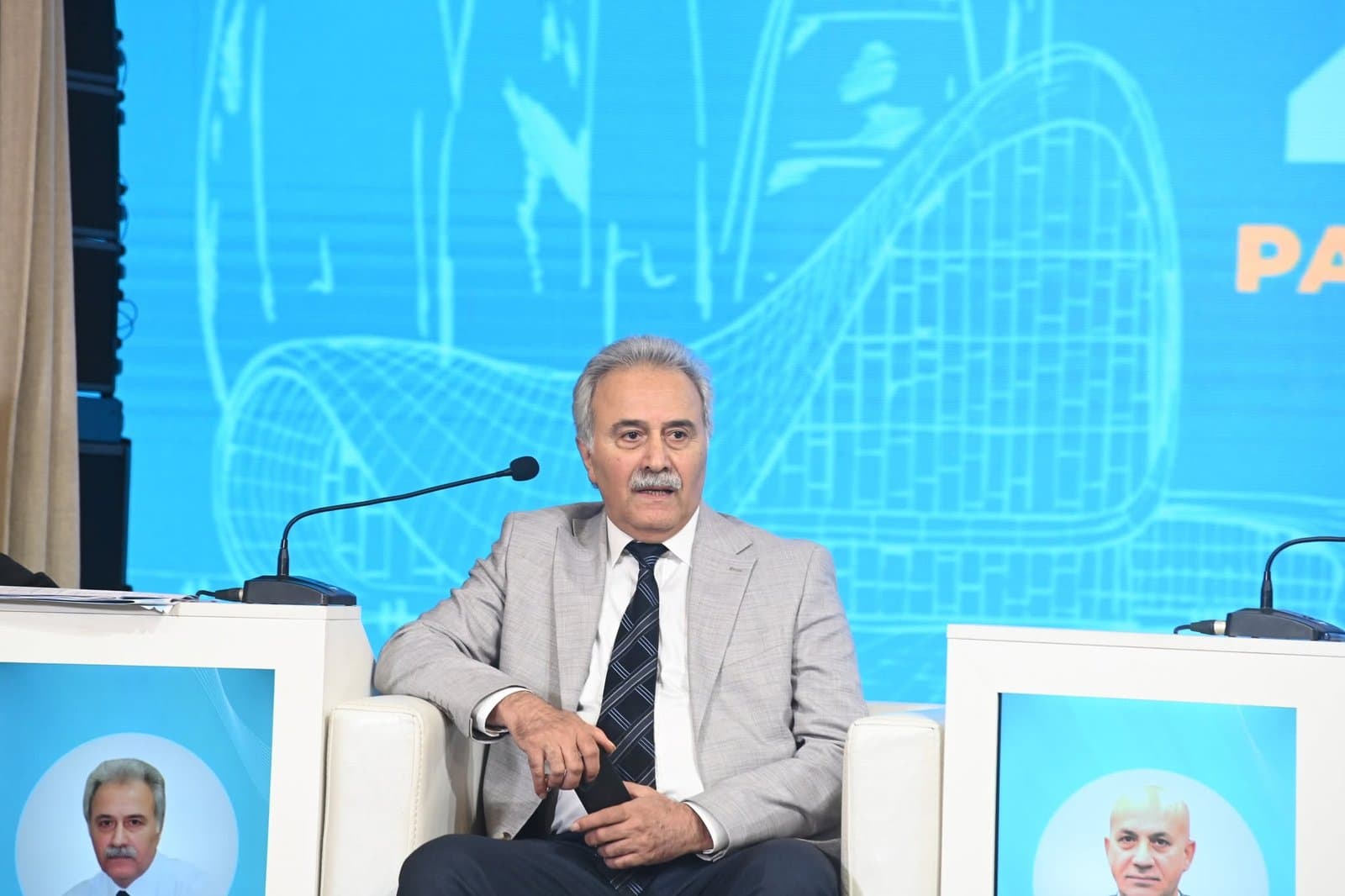


Director of the Institute of Economics, ANAS, Professor Nazim Muzaffarli made a presentation on "The potential of liberalization of the economy of Azerbaijan and the main vectors of strategic road maps".
On February 07, 2018, the Economic Reform Analysis and Communications Center and the Institute of Economics, ANAS jointly organized  a roundtable titled "Strategic Road Maps: Theory and Practice." The main purpose of the event was the scientific assessment of the proposed reforms in the strategic road maps based on the methodology developed by the Institute of Economics, ANAS. Opening the event, Executive Director of the Center for Economic Reforms and Communications Vusal Gasimli told about the successful economic reforms in the country, economic growth, development of the non-oil sector, improvement of the country's position in international ratings and etc.
Then Director of the Institute of Economics, Professor Nazim Muzaffarli made a presentation on "Liberality potential of economy of Azerbaijan and the main vectors of strategic road maps". He said that recent studies conducted at the Institute took attention both of local experts and international experts: "The new term of economics theory is based on two economic philosophies - dirigisme and liberalism. Supporters of the first prefer the government's active involvement in the economy and its regulation on a large scale (dirigisme policy), while the other supporters prefer self-regulation mechanisms of economy (liberalize). The state has some forms of intervention to the economy, giving it model properties. That is, economic models differ from each other by the level of such interventions. We call them modularizing state interventions. According to our assessments, the economy has the potential to liberalize the economy and carried out reforms are more liberal in the country.
Prof.  N. Muzaffarli noted that, supporters of the dirigisme economy think that, the state should boost the welfare of the citizens by engaging in extensive business intervention in the economy; for ensuring the social well-being of economy the state must take on itself the solution of social problems. Studies by the Institute of Economics on the IL(R)E prove that liberal economies are relatively similar with the dirigisme economies of the same level of development it is more social-minded. Also, it is wrong to imagine leftness as socialism (or socialism as leftness) and can cause serious economic consequences. Therefore, it is wrong to avoid liberal reforms under the pretext of "socialism" and such reforms although not sufficient, but necessary for acceleration economic growth and increase public welfare! Strategic road maps suggest that the ratio between the public sector and the private sector will change in favor of the second; competitive environment will be developed (anti-monopoly policy); will be applied "golden rule" to transfers of oil revenues to the budget; will be reduced the tax burden of enterprises; will be improved business environment (including for foreign investors); will be simplified foreign economic interactions; monetary regulation will be based on the "floating exchange rate" policy. All these changes aimed at reducing the overall level of model creation intervention of the state into the economy. These anticipated reforms are basically liberal.
Then there was an extensive discussion of carried out economic reforms in the country, as well as their results and expectations. Experts were highly interested and appreciated carried out works by the Institute of Economics. Representatives of a number of government agencies and economists participated in the discussions on Strategic Road Maps (economics.com.az)