

ABOUT
The Index of Leftness (Rightness) of Economy – IL(R)E – is an indicator annually being published by The Institute of Economics since 2014. At the initial stage, the Index was calculated for the Eastern Europe and Central Asia (EECA), and for some selected developed countries (37 nations in total).
Detailed information on concept of the leftness and rightness of economy, methodology of IL(R)E calculations and corresponding analysis is available in: N.Muzaffarli. The Social Orientation of Economy in the Left and Right Systems. – Baku, “East-West” Publishing House, 2014 (in Azerbaijani and Russian).
= = =
All the governments and – regardless their predominant political-economic ideology – all the political groups proclaim the improvement of people's well-being as their ultimate goal. According to the left-wing political-economic ideology, the “shortest” path to achieve this goal is through more active government regulation, and to the right-wing one – through more economic freedom (economic self-regulation). The permanent competition between these two philosophies is one of the main driving forces of political-economic progress in modern world.
The leftness and rightness are features of real economies too – not only the ideologies. An economy itself can be (and in any particular case is) the left-wing or right-wing. The leftness-rightness of economy is measurable. For any particular country the IL(R)E indicates that its economy is lefter relative to any other country’s (countries’) economy, and righter than other’s (others’) economy. The index also measures the degree of leftness-rightness of the economy showing how far lefter (or righter) the economy of country “A” is relative to the economy of country “B”.
= = =
In any particular country and at any given time, the government intervention in economy is at certain level. Main differences between national economic systems (models) are derived from this level. Not all of the types of government intervention in economy are shaping models of market economy. Those types that are of model-forming nature are at the same time subjects for competition between left-wing and right-wing political groups (parties). The real (actual) degree of such types of government intervention determines the leftness-rightness of the economy. The higher the level of these forms of government intervention, the lefter the economy, and vice versa, lower intervention means relative rightness of the economy.
There is not any overall (universal for all economies) optimal value of IL(R)E. Countries with different level of leftness (rightness)of economy may achieve the same success in economic development and rising of public welfare. In opposite, countries with the same level of leftness (rightness) of economy may achieve different success in these areas. Some countries attain better results due to the rightness of their economy, others through the leftness. Besides, the optimum point of IL(R)E undergo change within time.
Nevertheless, the cumulative economic growth for several years in any particular country provides a certain ground to define how close the IL(R)E of that country is to its optimal level – the methodology that could be called indicative. It can also be useful in evaluation of government regulation changes in separate sectors of the economy. If government introduces more liberal (or stricter) regulation in any sector of the economy, and as a result, the development pace of that sector becomes higher than that of other sectors (or higher than overall economic growth rate), then policies are chosen properly and reforms of same nature should be continued.
= = =
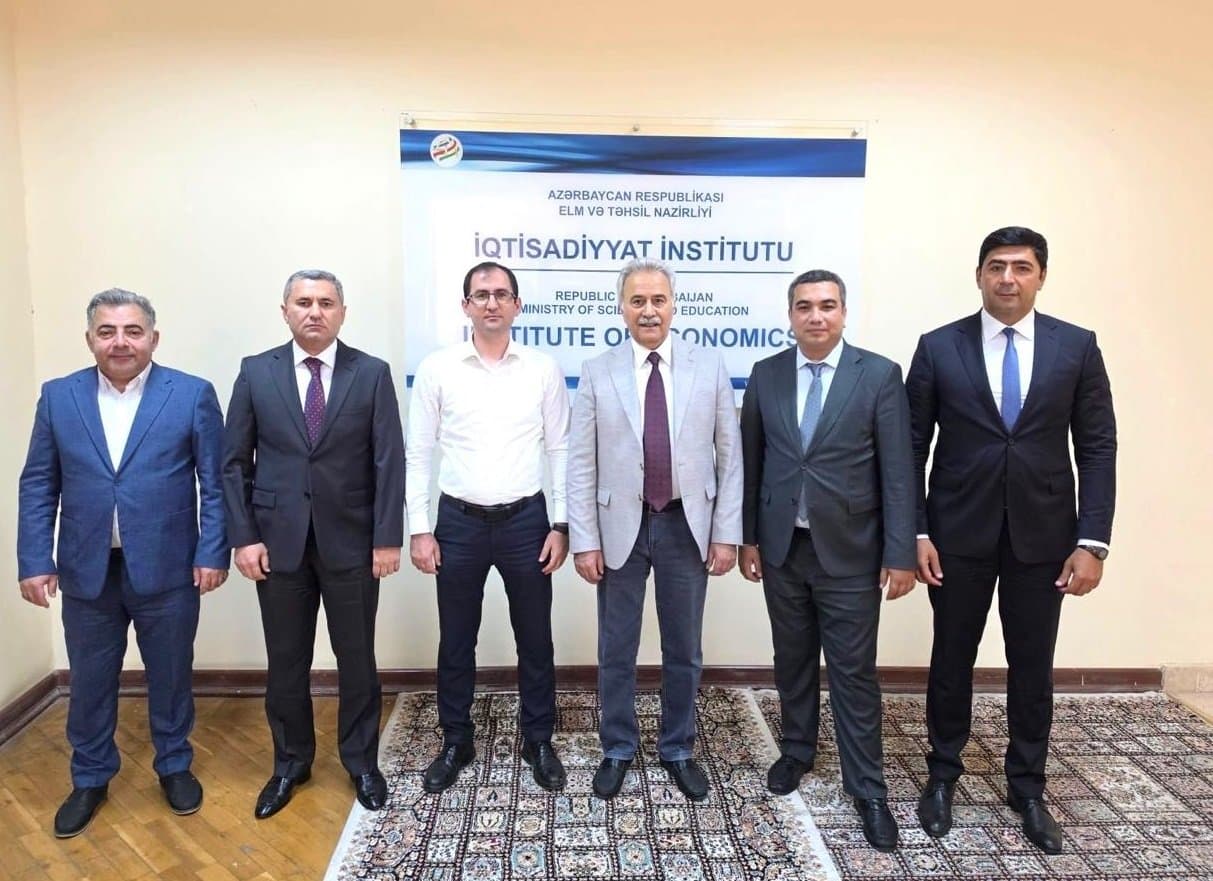
The research on the Index of Leftness (Rightness) of Economy is conducted by the group of experts:
Nazim MUZAFFARLI – Doctor of Economics, Professor;
Mayis GULALIYEV – PhD, Coordinator;
Allahyar MURADOV – PhD, Associate professor;
Rasmiyya ABDULLAYEVA – PhD, Associate professor;
Emin MAMMAD-ZADAH – PhD, Associate professor;
Farqana MUSAYEVA – PhD, Associate professor;
Rufat EFENDIYEV – PhD, Associate professor.
With special thanks to Bahruz AHMADOV, Mahir ZEYNALOV, Ali VALIYEV and Ruzi MAMMADOV for subsidiary analytical efforts.