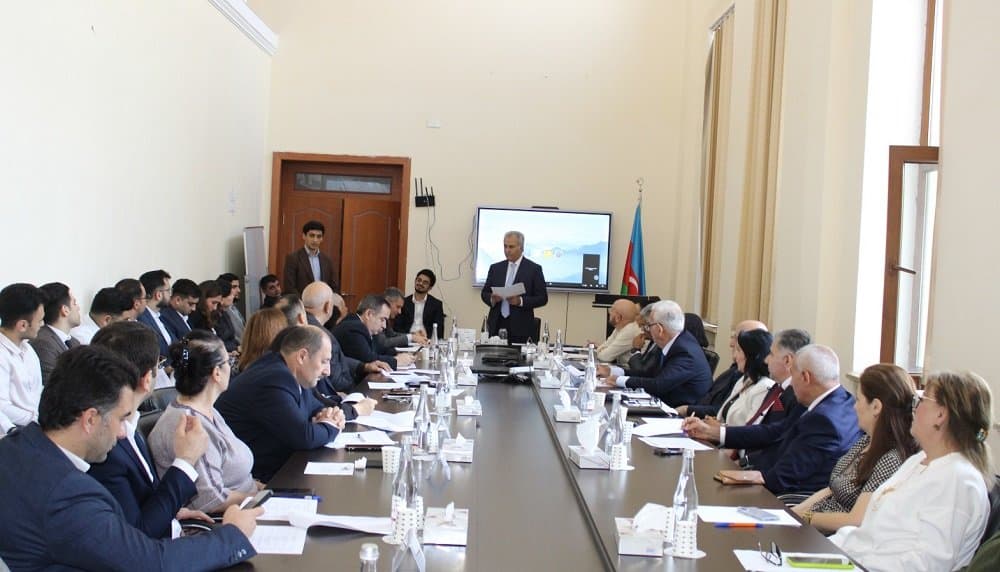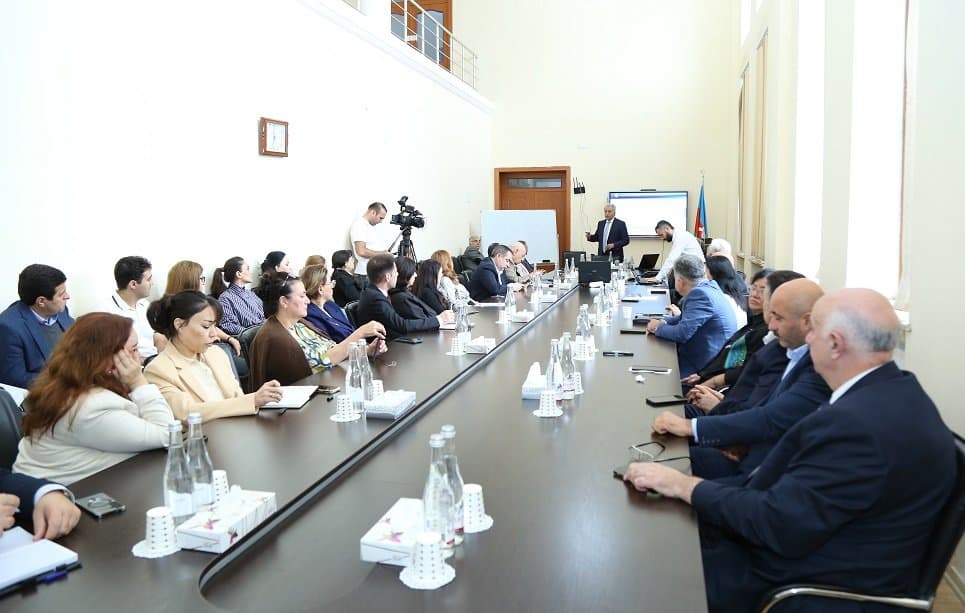


On February 5, 2020, at the National Aviation Academy (NAA) Professor Nazim Muzaffarli, Director of the Institute of Economics of ANAS, made a report on the “Optimality interval between liberalism and dirigisme of the economy” at the international scientific-practical youth conference “Creative potential of youths in solving aerospace issues”. The event attended by the professors and teachers board of the National Aviation Academy and a group of employees of the Institute of Economics of ANAS
The event was opened by the head of the Department of World Economy of the National Aviation Academy, Prof. Salim Muslimov and presented the speaker. He noted that the fundamental researches carried out at the Institute of Economics of ANAS was closely followed by the scientific community and underlined the need for close cooperation of scientific and educational institutions.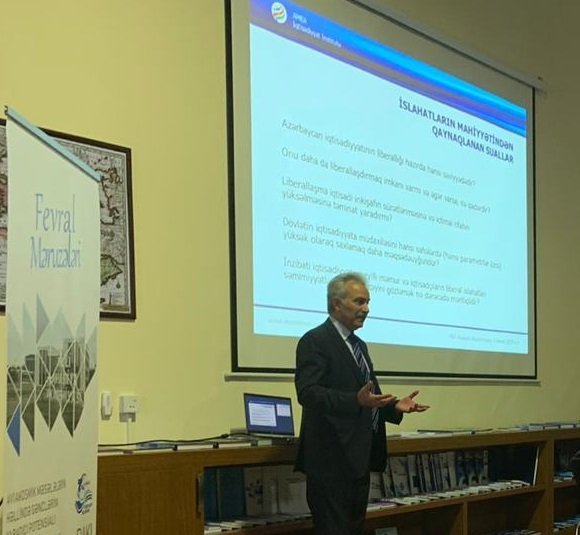 Professor Nazim Muzaffarli said in his report that according to strategic road maps, the ratio between the public sector and the private sector will change for the better; a competitive environment will be developed (anti-monopoly policy); the “golden rule” will apply to the oil budget transfers; will be simplified tax burden on enterprises; will be improved business environment (including for foreign investors); will be simplified foreign economic interventions; monetary regulation will be based on a floating exchange rate policy. All these changes are aimed at reducing the overall level of modeling interventions of the state to the economy. The proposed reforms are mainly right-liberal inclination.
All economic theories (schools) and political forces claim that their goals are to accelerate economic development and increase social prosperity. But so that the rightness believes, the state should intervene as little as possible in the economy and prioritize mechanisms of self-regulation. However, the Leftness, think that the state must actively regulate the economy prevention for market failures. And, depending on the REAL (actual) level of modeling interventions in the economy, the economy in itself receives the signs of leftness-rightness (dirigisme-liberalism).
Prof. Nazim Muzaffarli noted that, contrary to the listings (ratings and rankings) of all the leading analytical centers in the world, according to research conducted by the Institute of Economics of ANAS, in the listing does not include “good” – “bad”, “leading” – “lagging” countries and there are countries with leftness-rightness economy. According to the Index of Leftness and Rightness of Economy, calculated by the Institute of Economics, ANAS on 95 countries, the optimality intervals between liberalism and dirigisme in the economy from country to country differs and changes time by time. Countries with liberalism and dirigisme economy may develop in the same progressive level. Economies of some countries are developing more successfully through liberalism, on the contrary other countries develops for dirigisme. Each country strives to create a balance between market self-regulation and state regulation that can be considered effective (ideally - optimal) for itself. However, the country is as much as closer to the interval of optimal balance (but inside of interval – to the optimum point), its socio-economic development will be faster. 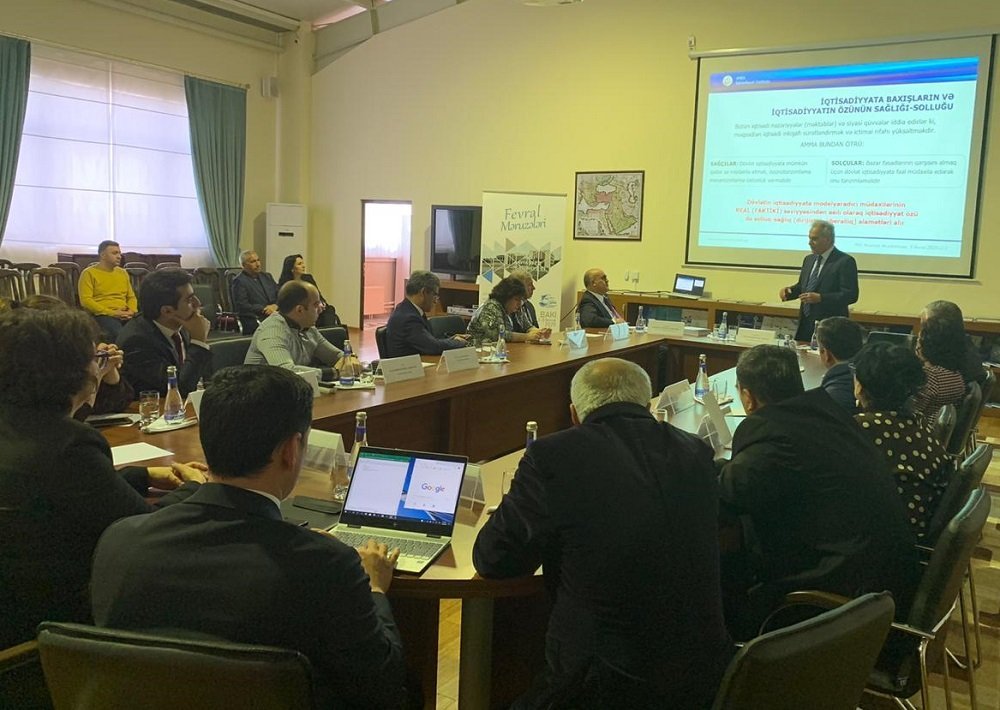
With a 0.310 cost Azerbaijan is in a member of the group of central countries of L(R)IE. The cumulative growth of real GDP in 2013-2017 was 6.7%. But in 2012-2016, it was 8.2% and in 2011-2015, it was 12.4%. This indicator is lower than the average of countries in the central group on L(R)IE. In Azerbaijan, the L(R)IE is in the left side from its optimal price (optimum interval), so that liberal economic reforms will remain relevant in the coming years.
Supporters of the economy believe that the state must intervene in the economy and improve the welfare of its citizens; In order to ensure the social orientation of the economy, the state should take on the solution of social problems.
Supporters of the dirigisme economy consider that the state must intervene in the economy and improve the welfare of its citizens; in order to ensure the social orientation of the economy, the state should take on the solution of social problems. Research on L(R)IE by the Institute of Economics of ANAS, proves that liberal economies at approximately the same level of development could be more socially oriented than the dirigisme economies and in many times they are so; thinking the leftness as social orientated (or, on the contrary, the social orientation as the leftness) is wrong and can be caused serious economic consequences. Under the pretext of “social orientation” avoiding liberal reforms is a mistake! At the present, the liberal reforms are not a necessary condition, but a prerequisite for acceleration economic growth and increasing public welfare.
Then held interesting discussions around the report, answered the questions.
The questions can be answered later, questions will be answered.